by Howard Fosdick © 2026 FolkFluteWorld.com
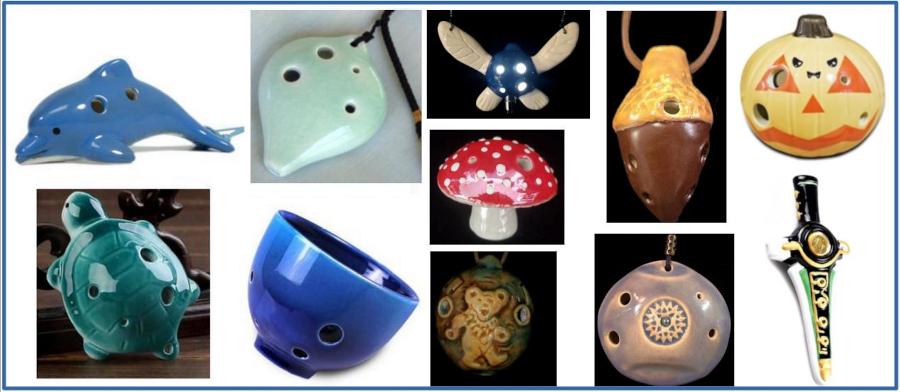
(Courtesy: EBay, SteinOcarina.com, STLOcarina.com, and SongbirdOcarina.com)
Pendant ocarinas come in all sorts of designs, shapes, and sizes. This photo montage shows just a few of the many hundreds available.
These happy little instruments are made, sold, and played on every continent. And no wonder -- they are inexpensive, easy to play, and fun to collect.
To top it all off, they are fully capable musical instruments. They're much more than just fun toys and cute collectibles.
Englishman John Taylor made all this possible with his invention of the "English" fingering system in 1964. Taylor figured out a way to play a full 8 note chromatic scale with a vessel flute that had only four fingering holes.
The key is that it the outer shape of the ocarina doesn't matter. Instead, the pitch of any note is determined by the size and number of open fingering holes, and the size of the air chamber.
Thus one can render the flute in any imaginable design (so long as the musician can still reach the fingering holes and blow into the fipple!)
It's important to note that Taylor's fingering system plays a complete chromatic scale. That is, it plays 8 whole notes plus all sharps and flats between them.
So this design can play any song, so long as it fits within the instrument's limited range.
The 6 Hole Pendant
John Taylor's friend Barry ("Baz") Jennings improved Taylor's 4 hole ocarina by adding two thumb holes on the instrument's underside. This added two more whole notes and extended the instrument's range from an 8 note span to 10 notes.
Given the somewhat limited range of the 4 hole pendant, these two extra notes come in handy. They open up the possibility of playing a greater variety of melodies.
Here's a photo that contrasts the basic 4 hole design with its 6 hole enhancement:
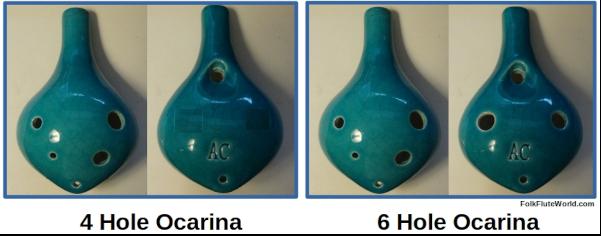
You might wonder: if the 6 hole design yields a more musically capable instrument, why do 4 hole ocarinas sell so well?
Beginnners sometimes find the 4 holer easier to play, since you can place your thumbs anywhere under the instrument to stabilize it while you play.
More importantly, some of the fascinating, fun designs makers invent don't lend themselves to the presence of underside thumb holes.
In any case, there's room for both 4 and 6 hole pendants in the ocarina universe.
Who Was John Taylor?
Englishman John Taylor (1941-2011) invented the 4 hole ocarina. He was an instrument maker, musician, and mathematician. It was his unique combination of these skills that enabled him to invent the pendant.
Taylor didn't just innovate clay ocarinas -- he worked in wood and other materials and created a wide variety of unique flutes.
John made his first instrument, a wood whistle, at age nine by cutting a notch in a piece of garden cane. As he matured, he evolved into a true polymath.
He not only designed and made musical instruments of all sorts, he also made his own clothes and shoes, and even whittled his glasses frames from wood.
Here's a photo of his workspace. It's a close-up so you can see all the fanciful designs with which Taylor was testing and experimenting. Notice those flutes shaped like figure-8's:
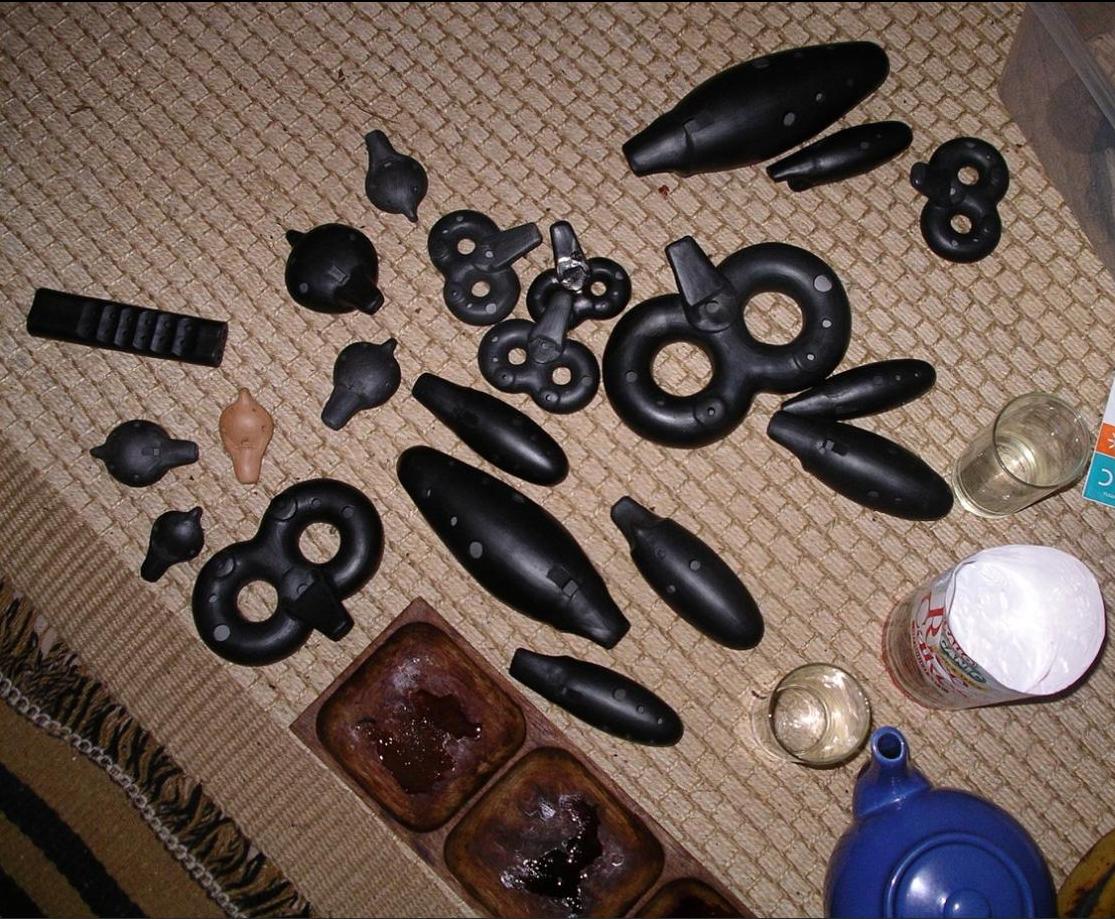
(Courtesy: Peter Hodkinson, Josie Hodkinson, and James Gregory)
Here are a couple photos of John Taylor. These are provided by the kind courtesy of the late Peter Hodkinson and his daughter Josie, and also James Gregory.

 (Courtesy: Peter Hodkinson, Josie Hodkinson, and James Gregory)
You can learn much more about John Taylor at this memorial website here.
Who Was Barry "Baz" Jennings?
Barry "Baz" Jennings (1940-2004) was a friend of John Taylor's who also innovated with ocarinas. He developed a nice business selling very high quality pieces, a talent which he developed himself starting in the 1960s.
Jennings took Taylor's 4 hole pendant and evolved it one step further by adding two thumb holes underneath. This 6 hole oc extended the range of the pendant by two more whole notes (from 8 to 10 whole notes, plus all chromatics between).
Here are a few photos of Mr Jennings. That's him in the insets as well:
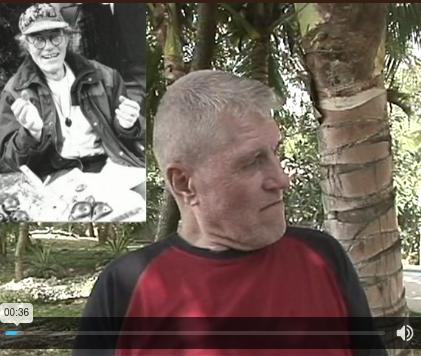
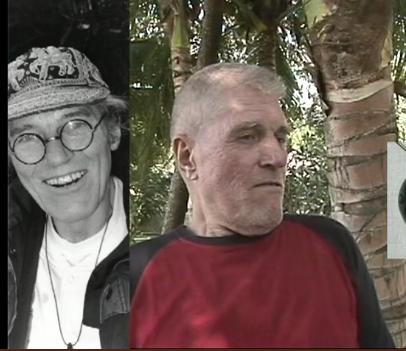 (Courtesy: Jerry Pollard)
You can learn more about Barry Jennings at this memorial webpage here. The website features two 25-minute interviews with Mr Jennings from 2004.
Summary
I created this webpage to help preserve the history of how the pendant ocarina was developed and who is due credit for it.
This remarkable invention is today popular worldwide. It is enjoyed by legions of amateur and professional musicians, pendant collectors, and schoolchildren.
If you'd like to learn more about playing pendants, read my article Learn to Play Pendant Ocarinas!
To learn more about all kinds of ocarinas, see my article An Introduction to Ocarinas.
Finally, you might want to learn about the 10,000 year history of the ocarina. It's more interesting than you might think: A Fun History of Ocarinas.
John Taylor (1941-2011)

 (Courtesy: Peter Hodkinson, Josie Hodkinson, and James Gregory)