by Howard Fosdick © FolkFluteWorld.com
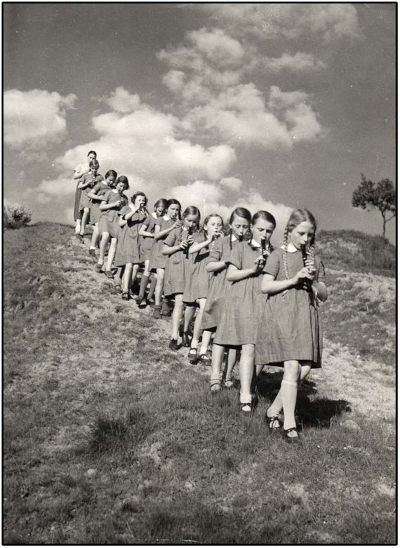
(Courtesy: George Mason University)
"The real reason everyone plays recorder in school is because of the
Nazis. The recorder was dead and they resurrected it, and now all those innocent grade-schoolers play it!
That's what my friend texted me the other day. Could it be true?
This article gives you the real story. We'll recount the history of recorders and the role the Nazis played in popularizing them in the mid-20th century.
Let's start with some background on where recorders come from and how they evolved.
Origins
The recorder is defined as an end-blown flute having seven top holes and one left thumb hole. Its mouthpiece automatically directs your breath to a splitting edge that produces sound waves.
The first evidence of recorders comes from Europe in the 14th century. The instruments attained widespread popularity during the Renaissance and Baroque musical periods (about 1400 to 1750 AD).
Key to their ascendency were the conical bore and their duct flute mouthpiece. The conical bore produces more pleasant, sophisticated sound because it produces more harmonic overtones than a straight "pipe" bore.
The duct flute mouthpiece makes the instrument easy to play because it automatically splits your breath into sound waves. You don't have to manage this yourself as you must with a transverse flutes like the standard concert flute.
Recorders were used for courtly dances, chamber music, in formal compositions, and in public ensembles for dancing and popular entertainment. Recorder ensembles were called consorts.
By the time of the Classical and Romantic musical periods (1750 to 1900 AD) recorder use had faded. And by the turn of the 20th century, they had pretty much died out. Only a few cognoscente knew of them and their special charms.
What Happened?
Some of the famous historic composers who wrote for recorder include Bach, Berio, Handel, Hindemith, Telemann, Lully, Moteverdi, Purcell, van Eyck, and Vivaldi. Henry the VIII was a big recorder fan: his flutes outnumbered his wives.
Given such prominence, how did the recorder fall out of popularity?
There are several reasons. Perhaps the biggest two are:
2. Instruments became mechanized and added keys
The change in materials allowed for much louder play in an era before modern electronic microphones and amplification. What came to be known as concert instruments like modern brass and woodwinds could entertain much larger audiences and support larger public performances.
The addition of keys made accidentals easier to play -- and rendered semitones much more pitch accurate. They also supported greater range. Witness the 3 1/2 octave range of the concert flute versus the 2+ octave range of the recorder.
The Comeback
The recorder's 20th century revival came about due to several convergent factors. Underlying them all was an interest in playing historic music on the instruments for which it was composed. Many came to view recorders with pride as an integral part of their cultural history. This trend occurred in several European countries more or less concurrently.
In the United Kingdom, the Dolmetsches, a father and son team, started making and teaching historical instruments. They promoted early music and specifically the recorder.
Edgar Hunt (1909-2006) took up the baton in the UK in the 1930's. He furthered interest in early music and promoted the recorder's role in music education. Hunt introduced the first inexpensive recorders to the UK by importing them from Germany. These featured baroque rather than German fingering.
Together with Carl Dolmetsch (1911–1997), Hunt founded the UK's Society of Recorder Players in 1937.
In the Netherlands, world-class musician Frans Brüggen (1934-2014) played a similar role in bringing recorders back to center stage.
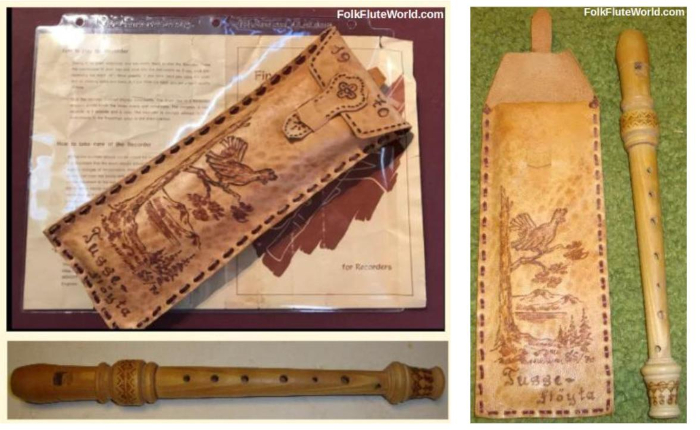
(Courtesy: FolkFluteWorld.com)
In Norway, Egil Storbekken (1911-2002) more or less single-handedly revived interest in early or authentic
Scandinavian music. Storbekken created his tussefløyta or "troll flute" recorder. Here's one of them along with its hand engraved leather case.
This folk flute has no double holes and fingers in the German system. The engraving is a lovely Norwegian nature scene.
We cover the role of the Nazis in popularizing the recorder in the next section, but here it's interesting to note that Storbekken became a member of the Norwegian Nazi party, the Nasjonal Samling, in 1940. He was attracted to it due to their interest in reviving traditional Norwegian culture (such as his folk instruments). But soon Nazi actions revealed to Storbekken their true nature, and he regretted and repented of his joining.
Germany and the Nazi Connection
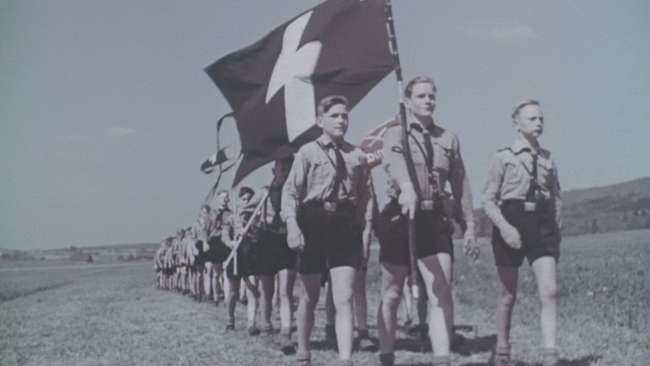
(Courtesy: natgeotv.com)
Germany instrument maker Peter Harlan (1898-1966) invented the recorder's German fingering system in the 1920s. Together with composer and music educator Carl Orff (1895-1982), he contributed to a German recorder revival. Around this time, the Nazis showed up and Hitler grabbed power.
To paraphrase William Shirer -- author of The Rise and Fall of the Third Reich --
Everywhere you looked in 1930s Germany you saw children marching, marching, marching ... beating drums, and singing.
The Hitler Youth (or Hitlerjugend) embodied Adolf Hitler's plan to brainwash and direct German youth. It was a paramilitary organization designed to inculcate the young with Nazi values. At its height it enrolled millions of youngsters age 10 to 18 and was the only youth organization permitted in Nazi Germany.
The BDM (or Band of German Maidens) was the equivalent organization for girls.
Group-think, marching, song, and military training were fundamental to both Nazi youth groups. In this spirit, the Nazis seized upon the recorder as a native totem of superior Aryan culture. They claimed the recorder as an indigenous Germanic invention. Needless to add, Nazi flutes features German fingering.
The Hitler Youth famously played one of Orff's original compositions at the 1936 Olympics in Berlin. One of the attendees was Japanese Yoshitaka Sakamoto. He was so impressed that he acquired a few recorders and took them back to Japan, where he prevailed upon Yamaha to start manufacturing them. This first planted the seed for the recorder's present day popularity in Asia and Japan.
The Nazi empire fell in 1945, but their recorder revival lived on. The instrument remained central to music education in many countries, as originally boosted into that position by the Nazis. German fingering continued its influence as an educational and "folk flute" version of recorder, though over time its limitations in accurately voicing accidentals restricted its wider popularity.
Today German fingering retains some popularity in schools and among folk flute hobbyists. But all serious and professional recorder musicians play baroque fingered instruments.
Conclusion
It's quite an exaggeration to say that we play recorder today because the Nazi's revived them in the 1930s and 1940s. As we've described, the recorder resurrection occurred in several European nations at roughly the same time in the early to mid- 20th century.
But it is true that Nazi policy had an important role in raising the profile of the recorder on the continent during 1930s and 1940s and placing it at the center of early music education. This demonstrated both the value of recorders in music education, and their versatility as a general purpose instrument.
Today many people worldwide agree that the recorder's unique advantages -- ease of play, versatility, portability, and low cost -- afford the instrument a special role in music making and education.
Related Articles
You may be interested in my related articles: