All About Ocarinas, Recorders, Tin Whistles, and Native American Flutes
by Howard Fosdick ©
FolkFluteWorld.com
New, updated, and expanded for 2025

Today we'll look at four folk flutes: ocarinas, recorders, tin whistles, and Native American flutes.
We'll answer basic questions
about each. Which are easiest to learn? Best for certain kinds
of music? Least inexpensive? Most expressive? I'll provide some simple answers.
All these flutes are fipple
flutes -- you blow into a mouthpiece that directs your
breath to make sound.
That makes them much easier to get started
with than concert flutes or other kinds of transverse flutes. With those flutes
beginners spend days blowing into the mouthpiece just to learn how
to play notes.
Folk flutes are simple to learn, inexpensive, portable, and there
are tons of how-to videos and free sheet music on the web. I'll provide
links to all that free material.
Folk flutes make excellent teaching tools for kids. If you're an adult, these flutes are the quickest and easiest way to learn a musical instrument.
Let's take a close look at these four kinds of flutes. I'll include sound samples and links to free resources.
Here's the agenda:
Ocarinas
Ocarinas are vessel flutes: flutes that resonate sound waves within a closed air chamber. They do not have open-ended bores as do recorders, concert flutes, or tin whistles. This gives them their unique "full" or "rounded" sound.
To give you an idea of their distinctive sound, click here to hear Lena Leclaire play a Legend of Zelda medley.
Ocarinas are the perfect beginner's musical instrument. Anyone can learn to play them, from kids to adults who have never played an instrument before. For the price of a meal, you can acquire an instrument that will give you a lifetime of enjoyment.
The ocarina's main limitation is that they have less range in pitch than expensive mechnical instruments like concert flutes or clarinets.
(Also, there's no separate mouthpiece to push in or out, so you can't tune them.)
Three Kinds of Ocarinas
Ocarinas date back thousands of years to the ancient Chinese and Mesoamerican civilizations. Italian Giuseppe Donati invented the modern "oc" in the 1850s. He standardized the instrument so that it could play western scales with simple fingering.
Ocarinas -- or "ocs" -- are typically made of ceramic clay, plastic, or sometimes wood. They come in many shapes but categorize into three: transverse, inline, and pendant.
The photo below shows two transverse ocs on the left, two rectangular inlines in the middle, and two round pendants on the right.
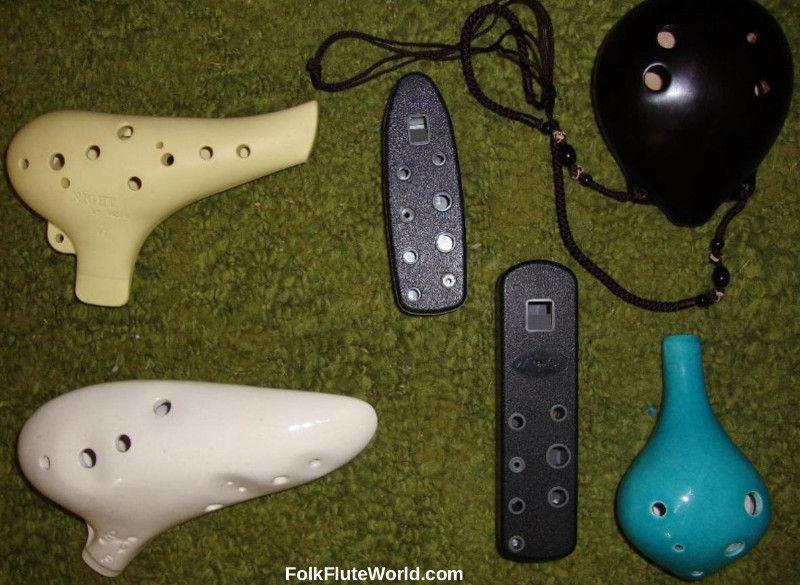
Yellow Plastic and White Ceramic Transverse Ocs; Two Black Plastic Inlines; Two Ceramic Pendants
Transverse Ocarinas
Because of their shape, transverse ocs are sometimes called sweet potatoes or submarines. You play them sideways, like a metal concert flute. Put your mouth on the extended fipple and blow while placing your fingers over the holes.
Submarines typically
have 8 to 10 fingering holes on top, and two thumb holes underneath.
The more fingering holes, the more notes you can play. For example,
the yellow oc in the upper lefthand corner plays a range of 13 whole notes -- certainly enough to play any song you
like.
The yellow oc is the most popular size
of ocarina -- most people call it the Alto C. (Terminology is notoriously unstandardized
so you may hear it referred to as a C Major ocarina.) Other sizes include the smaller
soprano, larger tenor, and the still larger bass.
The bigger the oc,
the lower it sounds. And the softer its voice. Small ocs can be
pretty loud, so sometimes people buy larger ones so as not to
disturb others. Bigger ocs cost more, of course.
Inline Ocarinas
Inlines differ from submarines in that they're shaped like TV remotes. They they extend straight out from your mouth when you play them.
You finger transverse and inline ocs in the same way. You play up the scale simply by removing one finger after another from the fingering holes. (As folk instruments, different brands of ocarinas sometimes have very minor fingering differences.)
Pendants
Two pendants are on the righthand side in the photo. All pendants have 4 top holes. Many also have 2 thumb holes beneath.
Pendants have an entirely different fingering system than the transverse / inline system. You have to memorize it. Fortunately, it's not too difficult.
These ocs are called pendants because most have attached necklaces so that you can wear them around your neck, like the black oc in the photo. Pendants are also called seedpods. Most people use the terms pendants and seedpods interchangeably.
What makes pendants fun is that they come in so many different shapes -- animals, flowers, fantasy creatures, teacups, and more. They're not only cute collectibles but they're also playable musical instruments!
Beware of unplayable pendants. There's a whole universe of decorative ocs -- many from Latin America and China -- that make attractive shelf pieces but are not playable musical instruments. You can spot them because all their top holes are the same size. A playable oc has different-sized finger holes.
You can learn more about pendant ocarinas in my article Learn To Play Pendant Ocarinas!
To ensure you don't accidentally buy an unplayable pendant, you might want to scan my article on How to Spot Unplayable Flutes.
Where To Start
If you're new to ocarinas, the best place to start is the transverse Alto C (sometimes called the C-major ocarina). It's the most popular ocarina.
Its fingering is intuitive. You progressively raise your fingers off the holes to ascend the scale, just like you do with recorders or tin whistles. These ocs can play all sharps and flats.
With the Alto C, you can play sheet music written for all ocarinas, plus all that scored for other C instruments, like the soprano recorder.
For your first ocarina, the big question is: Should you buy a plastic oc, or a ceramic one? Plastic ocs have a better track record for quality control and are more durable than ceramic. But some fans prefer the more traditional sound of ceramic ocarinas. If you opt for clay, stay away from the cheapest offerings. They'll likely disappoint.
Excellent plastic ocarinas are available for under $40 USD, while ceramic ones with good Amazon ratings cost a bit less than that.
Read reviews before you buy, and be sure to listen to a sound sample, too. Some ocs are not well tuned: remember, these are folk instruments.
If you're new to ocarinas, I recommend buying a quality plastic oc to start: the Focalink Bravura or Osawa, or the Night By Noble. These instruments are of consistently high quality, they play all notes well, they're durable and cleanable, and they cost less than $40.
More about my recommendations appear in my article Beginner's Guide to Buying an Ocarina.
Everything you need to learn to play is free.
Ocarina - Free Resources
Learn more about Ocarinas in my article Beginner's Guide to Buying an Ocarina.
Learn more about pendant ocarinas in my article Learn To Play Pendant Ocarinas!
Other free resources include:
Product reviews: The Ocarina Network's online forum, Ocarina reviews at Amazon, Ocarina reviews on Youtube
Community: The Ocarina Network's Facebook group, The Reddit ocarina community
Free sheet music: 12HoleOcarina.com, Pinterest posts, STLOcarina, OcarinaSongbook , OcarinaTabs
Recorders
You're probably familiar with the recorder from your school days. For every few notes you heard, you likely also remember a squeak or squawk.
Don't let that fool you. Listen to how beautiful recorders can sound. Click on a photo to listen...

by Paul Barton

by CG @Youtube

Recorders are end-blown flutes that trace their ancestry back to medieval Europe. When classical composers wrote for "flute" before the 19th century, they were often referring to what we today call the recorder. The modern metal concert flute wasn't perfected until the mid-1800s.
Like ocarinas, recorders feature simple fingering for whole notes. Among their several fingering systems, the most popular is called baroque or English fingering.
Recorders come in standard sizes like sopranino, soprano, alto, tenor, and bass. As with ocarinas, the bigger instruments are both lower-pitched and quieter. So a soprano projects better if you play outside, while a soft-spoken tenor might well suit for quieter play inside.
Bigger also means more expensive. The tenor in a company's line will cost more than its alto and much more than its soprano.
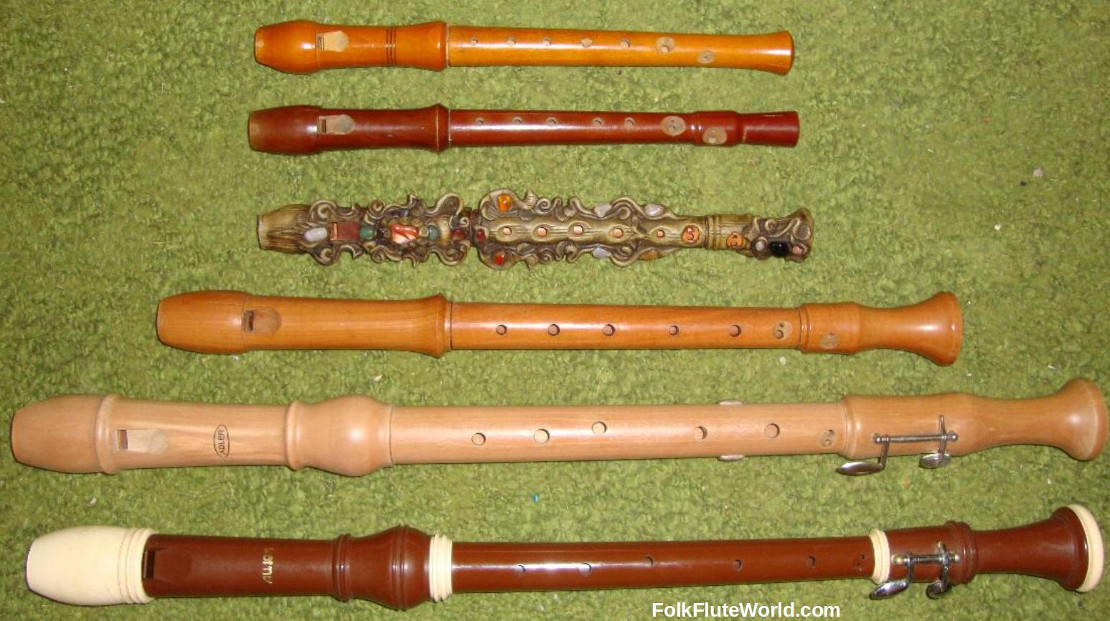
Top to Bottom: Two Pearwood Sopranos, Decorated Ceramic Soprano, Maple Alto, Maple Tenor, and Plastic Tenor
Where to Start
Almost everyone starts with the ubiquitous soprano. More lessons, sheet music, and other resources are available for the soprano than any other size of recorder.
Its pitch ranges over two full octaves (from C5 to D7), with all sharps and flats between. So you can play any kind of music you like, from jazz, to pop, to classical.
ABS resin plastic is an excellent choice for a first instrument. It's inexpensive and sounds great, yet it's durable and easy to take care of. Top notch plastic recorders cost only $20 to $40 USD.
Wood is the traditional material for recorders. It's more expensive, with prices ranging from $30 to $90 USD on the low end, up to hundreds for the mid-range, and thousands for the top instruments.
The less expensive ones are factory produced from woods like pearwood or maple. Craftsman create the more expensive ones from specialty woods.
Keep in mind that price alone doesn't determine quality. Sound is subjective and personal taste differs. The skill of the player often counts more than the quality of instrument.
If you're new to recorders, my recommendation is that you start with a quality ABS resin plastic soprano from Yamaha or Aulos. Nearly everyone agrees these two companies make the best plastic recorders. A Yamaha 300 series or Aulos 500 series costs only $20 to $40 USD.
With its tunability and two-octave range, the recorder offers ensemble fun and musical possibilities beyond those of many other folk instruments.
Recorder - Free Resources
Learn more about recorders and which to buy in my Beginner's Guide to Recorders.
If you're interested in the tenor recorder, see my Beginner's Guide to the Tenor Recorder.
Other free resources include:
Product reviews: Sarah Jeffery's recorder reviews, Recorder reviews at Amazon, Recorder reviews at Youtube
Community: American Recorder Society (website), American Recorder Society (Facebook),
Reddit recorder community, A Facebook Recorder group
Free sheet music: 8Notes, Sheet music at Pinterest, Free-Scores.com, The Solo Recorder, Virtual Sheet Music
Tin Whistles
Tin whistles are also called penny whistles or Irish whistles. Like ocarinas and recorders, they trace their heritage back to the earliest civilizations. The modern whistle is a much more recent invention. Only in the 19th century did it standardize in its present form.
Here's how the tin whistle sounds in the theme song from the film Titanic, and how it sounds in the music of the pagan-folk band Omnia.


The instrument's forte is traditional Irish, Scottish, and Celtic music. Yet it's versatile enough to play American folk music or any other genre you wish.
As the photo shows, penny whistles come in many different keys. The D whistle is most common. These measure a bit less than a foot long and are surprisingly lightweight. As with ocarinas and recorders, larger instruments have lower pitches.
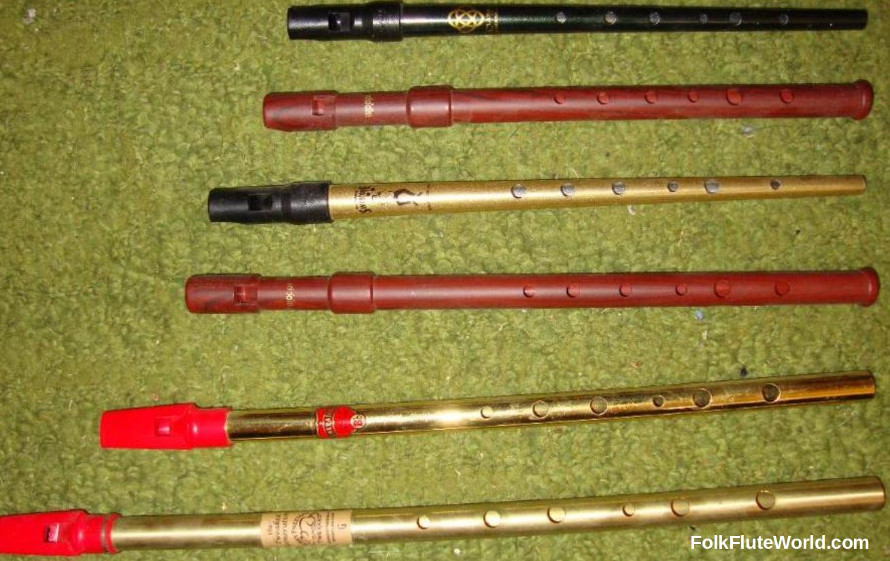
Top to Bottom: Two Whistles in D, Two Whistles in C, B♭ and G Whistles in Brass
One of the delights of whistling is the variety of instruments
available. Some pipes have tapered bores while others are straight.
They're made from all sorts of metals: brass, nickel, nickel-plated
brass, tin, aluminum, even lead (back before they learned it wasn't
safe). Other materials include ABS resin plastic, wood... and even
home-mades from PVC
pipe!
The tubular body of the instrument combines with a fipple, or mouthpiece. These can be plastic, wood, or metal; and either separate or built-in. Only whistles with separate fipples are tunable.
Add it all up and you have a gloriously varied universe of whistles to explore. Based on different design and materials, some whistles sound bright and clear; others, musky or rustic; and still others, soft and warm.
Whatever your taste, there's a whistle to match it. Part of the fun of whistling is finding your favorite pipe. With whistles being so inexpensive -- many only $15 to $30 -- players often build collections.
Playing
Penny whistles finger like transverse ocarinas and recorders in that you progressively lift fingers to hit higher notes. But the similarities end there.
Whistles have only six top holes and no thumb holes beneath. With a pitch range of about two octaves, you achieve the higher octave by overblowing the instrument. You finger the higher octave the same as the lower, and hit the higher notes by blowing harder.
This is an entirely different approach than instruments like the recorder where you finger the "octave hole" with your thumb to move up an octave.
Overblowing makes tin whistles easy to play because you finger the notes in the lower and upper octaves the exact same way. The only difference is how hard you blow.
Like alto C ocarinas, high notes on the D whistle can be loud -- they might disturb close neighbors. Experienced players learn to clearly articulate high notes with a nice tone. Or, you can just play a lower pitched whistle with a softer voice.
With its two-octave range, the whistle lets you play any kind of music. It can play all sharps and flats, yet most consider the whistle a diatonic instrument, one that plays whole notes but no sharps or flats.
Why? Those sharps and flats involve not only cross-fingering but a lot of half-holing -- covering half of a hole with your finger. This requires some practice, especially with fast tunes.
A simpler approach is to to switch keys simply by playing a different whistle. Or, change the key of the tune to fit your whistle.
The popular D whistle sounds D5 as its base note. (That's one note above the C5 base note of alto C ocarinas and soprano recorders.) It's a fairly high-pitched instrument.
D whistles pop out quick-fingered notes in a bright, dynamic way that makes them ideal for quick dance tunes, happy jigs, and the like. Ornamentation shows off well. Many players enjoy learning fancy techniques for Celtic music. But those aren't necessary unless they interest you.
Where to Start
Which whistle should you start with? Yikes, you'll get a ton of advice on this topic! Just like ocarina and recorder players, everyone promotes their favorite.
When I started playing the whistle a few years ago, I found I could immediately hit all the notes clearly and cleanly with the Clarke Sweetone. I don't know if it's the best whistle ever made but it's surely a great one to start with. It's got a pleasing tone, too. For only about $15 USD. You can't lose with it.
If you have an interest in Celtic culture, or you'd just like an inexpensive start with an incredibly expressive instrument, the penny whistle might be for you. You can see if it suits you for less than $20.
Tin Whistle - Free Resources
Learn more about whistles in my Beginner's Guide to Buying a Tin Whistle.
Here are other free resources:
Beginner tips: The Whistle Shop
Product reviews: Celtic Music Archives, Whistle reviews at Youtube, Whistle reviews at Amazon
Community: Chiff and Fipple forum, Reddit Group, Tin Whistle Irish Pub on Facebook, Tin Whistles on Facebook
Free sheet music: Irish-Folk-Songs.com, Whistle Tabs, Tin Whistler, 8Notes
Native American Flutes
The soulful sound of the Native American flute is so relaxing that many enjoy solo meditations on Youtube. Listen to these two examples:


Historically, Native Americans comprised a diversity of related peoples with different languages and cultures spread over a vast geographic area. They invented many kinds of flutes and developed varieties of each.
What we call the Native American flute today is the result of a standardization process that occurred in the 1980s. This evolution brought Native American flutes closer to conformance with European musical concepts.
For example, base pitches were standardized and the pentatonic minor scale, a five note scale, became predominant. The result has been an explosion of interest in Native American flutes.
Take a look at these flutes:
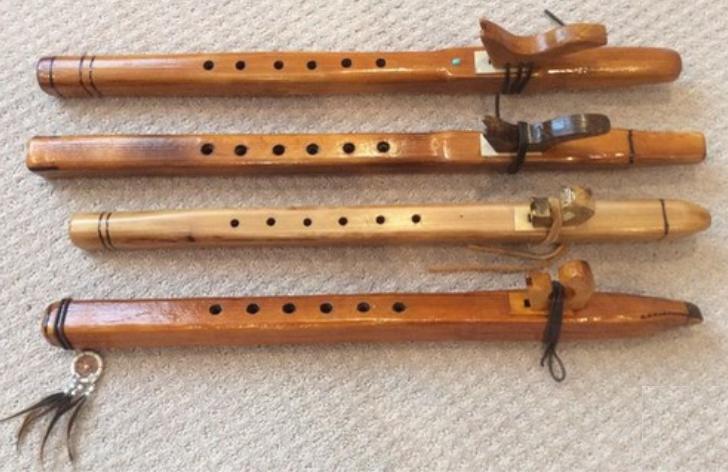
Native American Flutes (Photo from Frank B. on Pinterest)
As you can see, the flute is defined as having an external block held in place on top by a strap. You blow into a breath hole that connects to a small air chamber preceding the block. Your breath hits a splitting edge behind the block at the start of the larger sound chamber.

This cut-away diagram shows how this works. Your breath enters the first air chamber, passes through a flue, and then enters into the body of the instrument.
This unique design gives the Native American flute its special sound.
The instrument has either five or six top holes you finger to alter the pitch. (It has no thumb holes.)
Like tin whistles, Native American flutes are primarily considered diatonic instruments. Fingering whole notes is simple. Just progressively lift your fingers for higher notes. Sharps and flats are often possible, but fingering varies across flutes.
Most Native American flutes are keyed to the pentatonic minor scale. This lends them their soulful, contemplative sound. Advanced players can play other scales, too. The range of the instrument varies from 1 to 1 1/3 octaves. With some flutes you attain the highest couple notes by overblowing (blowing harder), just as with the tin whistle.
Where to Start
Similar to tin whistles, these flutes are crafted in every imaginable key. G is most popular. Many people are attracted to the sounds of even lower-pitched flutes, but not everyone can reach their key holes. So if you want to buy an F#, F, or lower flute, make sure you can comfortably reach all the holes first.
Six holes are better than five because they yield more notes. So most advise beginners to start with a six-holed flute in A, G, F# or maybe F. Of course, you'll also want to listen to any specific flute before you buy it.
Native American flutes are typically produced from woods like cedar, walnut, juniper, redwood, cherry or other more exotic choices. As with recorders, wood density affects tone (though not so much, perhaps, as the flute's design parameters.) Coloring often depends on staining techniques more than the wood used.
Given that the instruments are handmade, prices reflect labor costs. As with wood recorders, many cost several hundred dollars. However, there are excellent flutes available for under $100 if you seek them out, as my recommendations show.
Plastic is an option, too. Some feel that plastic flutes don't have the authenticity of handcrafted wood ones, but they're durable and can voice well.
You might enjoy joining a flute circle. These groups let you to socialize with other flute players, sharing and learning together. Search this list for a circle near you.
Its five-note scale makes the Native American flute incredibly easy to play. All notes sound pleasing together, so you simply can't hit a wrong one. That's the big draw to this instrument. Whether or not you have musical training, the Native American flute helps you express yourself.
Native American Flute - Free Resources
To learn more, start with my article All About the Native American Flute.
Beginner tips: Flute Tree Foundation, Ancient Territories
Encyclopedia: Flutopedia
Community: Facebook Native American Flute group, Facebook NAFlute group, Another Facebook NAF group, World Flute Society
Free sheet music: Flutopedia, Pinterest posts, and Flutetree
Comparison
How do our four kinds of flutes compare? All are easy to learn.
Yet the Native American flute stands out in this regard, with its simple pentatonic scale and limited fingering. It won't let you play a note that sounds out of key. This is truly an instrument anyone can play.
Ocarinas follow close on. If you can blow, you can elicit their soulful tones. Their limited pitch range means you need learn few fingerings.
Tin whistles and recorders are easy for beginners to start with, too. But they require greater effort if you wish to explore all their possibilities. Some whistlers progress into fast-fingered ornamentation and chromatics while some recorder players take on ambitious classical music.
In the end, the old saying applies to each of these folk flutes: It's easy to learn but takes a lifetime to master.
Compare this to traditional concert instruments. They're both hard to learn and difficult to master. And they cost hundreds of dollars!
You can get started with any our folk flutes for only $20 to $40 USD. Native American flutes are the exception, with their entry price of $70 to $100.
All the other resources you need are free -- tutorials, sheet music, how-to's, peer advice, instructional videos, and more. Find them all at our free resources page.
So what are waiting for? Grab a folk flute and begin your musical journey!
Summary Chart
| Transverse Ocarinas |
Recorders |
Tin Whistles |
Native American Flutes |
|
| Range: |
Varies, most 10 to 13 notes * |
About two octaves |
About two octaves |
Pentatonic, 1 to 1 1/3 octaves |
| Holes on top: |
8 to 10 |
7 ** |
6 |
5 or 6 |
| Thumb holes: |
2 |
1 |
0 |
0 |
| Price: |
$10 on up |
$10 on up |
$10 on up |
$80 on up |
| Common Materials: |
plastic,
clay (wood) |
plastic, wood |
various metals (plastic, wood) |
wood (plastic) |
| Tunable: |
no |
yes |
varies |
yes |
| Sharps and Flats: |
yes |
yes |
Usually considered diatonic but yes with half-holing |
Usually considered diatonic but most chromatics are possible *** |
| Overblowing? |
no |
no |
yes |
on
some flutes for a high note or two |
| Exceptional For: |
Popular tunes, folk music |
Classical music |
Irish, Scottish, Celtic music |
Native American music; meditation |
They require greater playing skill and cost more.
** Double holes count as 1.
*** See this discussion on scales and tuning.
My Recommendations
Here are popular, inexpensive flutes for beginners. They're easy to start with and produce great sound.
| Transverse Ocarinas |
Recorders | Tin Whistles | Native American Flutes |
|
| Plastic: | Alto C --
Focalink Bravura or Night by Noble |
Soprano -- Yamaha YRS-314B or 402B or Aulos 507B or 503B |
Susato or Dixon D Tunable |
Northern Spirit Flutes |
| Ceramic: | Alto C -- Focalink Pastoral |
----- | ----- | ----- |
| Metal: | ----- | ----- | Clarke
Sweetone in D |
----- |
| Wood: | ----- | Soprano -- Coolsma good at $50-$75 Mollenhauer several $30 to $90 |
----- | Laughing Crow or Gray Fox Flutes or Blue Bear Flutes or Stellar Flutes |
Beginners should start with --
- Ocarina -- plastic, rather than ceramic
- Recorder -- plastic, rather than wood
- Tin Whistle -- metal, rather than plastic or wood
- Native American Flute -- wood, rather than plastic