by Howard Fosdick © FolkFluteWorld.com
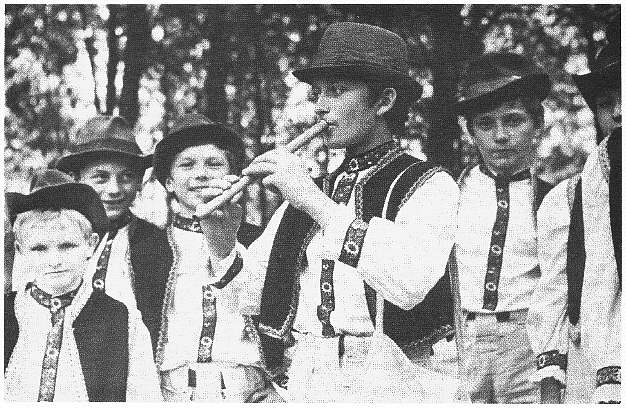
(Courtesy: Carpatho-Rusyn.org)
Have you ever looked at your recorder and wondered why it doesn't have 10 fingering holes instead of only 8? Wouldn't that give it a wider range and greater versatility?
The ten fingered recorder has always been a concept that's intrigued me.
Little did I know that such a "recorder" already exists. It's called the sopilka. Some informally refer to it as the "Ukrainian recorder". But as we'll see, the sopilka distinguishes itself from the recorder in aspects ranging from its sound to its fingering.
What we call "the sopilka" is actually a family of similar keyless flutes. What they all have in common are their basic design, and their Ukrainian origins. They are central to Ukrainian folk music.
While early forms of sopilka date back centuries, the modern sopilka has been made in 10 hole designs since 1967. This innovation was invented by instrument maker Dmytro Florovych Demenchuk (1942–2010). Ten holes is the predominate design today.
Details
(Courtesy: FolkFluteWorld.com)
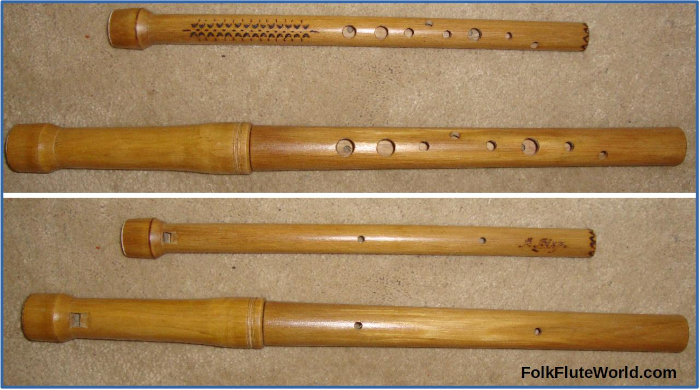
These photos show the tops and bottoms of two sopilka made from hornbeam.
Like recorders, sopilka can be made from wood, plastic, or other materials, but wood is by far most common. The reasons are two: Ukrainian tradition, and the close connection between the sopilka and nature (obviously a wood flute is more closely connected to nature than one made from plastic or metal).
Elderberry or viburnum wood are most popular, but you'll also see maple, walnut, beech and other woods, too.
Sopilka keys mimic those of common recorders: sopranino and alto in F, one octave apart; and soprano and tenor in C, also one octave apart. Sopilka pitched lower than the tenor exist but are rare.
But be aware that sopilka are less standardized than modern recorders. The larger flute in the accompanying photo was marketed as a "tenor", but in its pitch it actually corresponds to an alto recorder in F. (I've found that it's common to see altos named and sold as "tenors". To ensure you know what you're buying, always find out the fundamental or lowest note of any sopilka.)
Given the lack of standardization, there are many sub-varieties of sopilka and related flutes. Related Ukrainian instruments include the dentsivka, dvodentsivka, pivtoradentsivka, dudka-vykrutka, floyara, floyarka, vfrilkav, telenka, and vzubivka. If you want to explore this topic in more detail, this article provides some specifics concerning their design differences. Each has a separate Wikipedia entry.
How They Sound
Sopilka sound about as you would expect: similar to many other end-blown wood fipple flutes.
That's a bit different than most recorders. The reason is that the recorder has a conical bore -- the bore is tapered. The sopilka has a straight cylindrical bore. That gives these two flutes different overtones that account for their different voices.
You can find many sound samples on Youtube if you search for "sopilka songs" or "Ukrainian folk music". Here are a few examples -- click on each to view it:
Playing the Sopilka
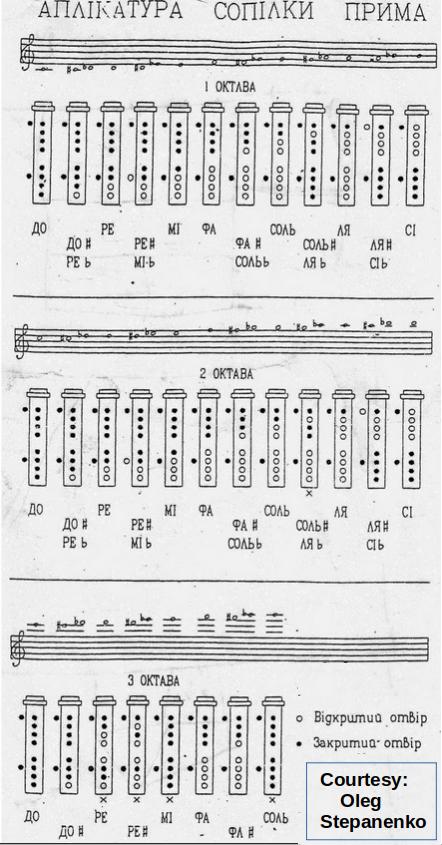
To play the sopilka, you have to learn its fingering. Although it features linear fingering, it differs from that of standard recorders. The claimed range is greater than that of the recorder, but you may not be able to play the highest notes on your instrument (it depends both on the instrument and your skills).
Here is a sopilka fingering chart.
You'll immediately notice one big difference from the recorder. You achieve upper octave notes by overblowing -- like a tin whistle -- rather than by covering half a thumb hole -- like a recorder.
You attain the third octave by overblowing even harder. Thus in this important respect playing the sopilka is more like playing a tin whistle (aka pennywhistle) than a recorder.
But of course, like the recorder the sopilka is fully chromatic.
Also note that you don't have to half hole (cover half of any hole) to play any of the accidentals. Ten fingers gives you the flexbility to avoid this. Compare this to some recorders and ocarinas that either have double holes for playing low accidentals, or have single holes and require you to half hole to play low accidentals.
Sopilka take advantage of your ten fingers to avoid both half-holing and the need for double holes.
How tonally accurate is the sopilka? Obviously it depends on the instrument. While sopilka are sometimes played in formal ochestral settings, most people think of them as folk instruments. Their tonal accuracy easily meets this standard.
Popular Revival
As mentioned before, sopilka have been around for centuries in various forms. The current ten fingered version dates back about 60 years.
Perhaps because of this design, there has been a huge revival of interest in both the sopilka and traditional Ukrainian music. The emergence of an independent Ukraine in 1990 after the collapse of the Soviet Union is also undoubtedly another factor in this resurgence. The sopilka has become a national symbol for modern Ukraine.
Sopilka are found in various musical subgenres including the songs of the Hutsuls of the Carpathian Mountains, Bukovinian folk music, and Klezmer music.
Both popular folk bands and rock groups make use of the sopilka. Wikipedia cites groups such as Ruslana, Haydamaky, Kubasonics, ONUKA, and Kobza, KoraLLi, and Kazka as examples.
And finally, the sopilka has entered the concert hall. Among the most prominent classical musicians playing sopilka is Boshena Korchynska. Hear her in the Youtube video above playing Paul Desmond's Take Five.
Conclusion
The sopilka is a fascinating instrument that combines attributes from the recorder and tin whistle. With its ten fingering holes, it takes those two instruments to another level, with great scope for intonation, range, and ornamentation. If you play flutes and are looking for a new challenge, the sopilka will prove rewarding.
Most sopilka are handmade in Ukraine and a few adjacent countries. You can purchase sopilka from dealers in ethnic flutes. Vendors on Etsy and Facebook Marketplace both sell authentic sopilkas.
Related Articles
You may be interested in my related articles: