by Howard Fosdick © FolkFluteWorld.com
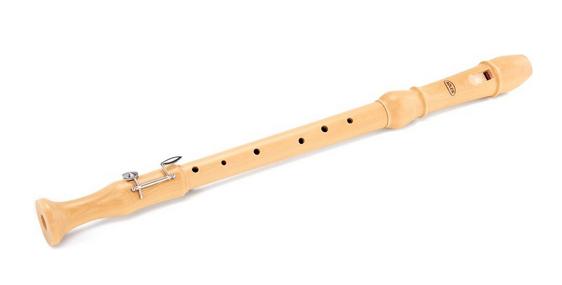
The Adler Tenor Wood Recorder (Courtesy of Adler)
If you're like most recorder players, you started out with a plastic soprano. From there, perhaps you branched out with a quality wood soprano, or maybe you graduated to the more mellow alto.
Whatever path you took, at some point, every recorder player who really enjoys the instrument craves a tenor. Pitched a full octave below the soprano, its soft, low, resonant voice sounds haunting and soulful. Nothing else compares to it.
If you wish to acquire a tenor, one option is a plastic instrument. I recommend either the high-end Yamaha or Aulos.
These earn consistent 4.5 star reviews they score at Amazon (out of 5 stars possible). They are quality products, with great intonation, top quality control, and excellent playability. And they typically cost less than $75 USD! That's a flat-out bargain.
Ultimately -- though they sound lovely -- you can readily identify them by ear as high-quality instrumental plastic. While I and many others love that sound, it's not the same as the unique sound of a wood recorder.So, while many prefer their Yamahas and Auloses, there are always some who insist on wood. The problem is that wood tenors are quite expensive. Most cost several hundred dollars.
One Solution
The Adler brand -- also referred to as Adler Heinrich -- has traditionally offered one of the few solutions to this dilemma. They've long produced wood tenors retailing at $100 USD or less. Are they worth it? That's what this review will tell you.
First, a bit about the company. Adler has been around, in one form or another, for decades as a recorder manufacturer. The company has gone through several reorganizations in that time. It's even stopped and then restarted manufacturing more than once. You might see their instruments referred to under such names as Adler, Johannes Adler, or Adler-Heinrich.
It's important to understand that Adler recorders have changed over the years as the company has evolved. If you buy a vintage Johannes Adler tenor produced in the the 1960s, for example, it may be quite a different instrument than today's tenor. And both of those might sound different from an Adler manufactured in the 1980s. You get the idea.
This review specifically covers the current Adler tenor. It's sporadically available new from sellers such as Thomas Mann Music in the U.S. and Germany, or sometimes even at Amazon.
The Instrument
The Adler tenor is made in Germany. It comes in a light shade of maple, and is often referred to as unfinished. It breaks down into three pieces.
The instrument is available with either a single or double key for the righthand pinky finger. A single key allows you to play low C. That low C is pitched one octave below the low C of the soprano recorder. The double key version additionally allows for playing low C#.
The instrument will likely come packaged in a nylon carry bag, with cork grease, fingering chart, and moisture wiper. But this can vary, depending on where you buy it.
Reaching the Keys
Tenor recorders are large instruments, about 25" long. One question many people have is whether they can reach all the key holes comfortably with their fingers.
Nearly all tenors have a low-C key, though there are exceptions. The low-C key is necessary to close the bottom-most hole with your right-hand smallest finger. You wouldn't be able to cover the hole without the key otherwise because the reach is too far.
By my measure, it is 8 1/2" from the topmost key to the bottom-most one on this recorder. Thus, finger reach with this instrument is very nearly the same as that with single-key Yamaha and Aulos plastic tenors. The exception is that with the 3rd finger of the left hand, the reach is easier with the Adler than the others. So if you can reach all keys on the plastic tenors, you can reach all keys on the Adler.
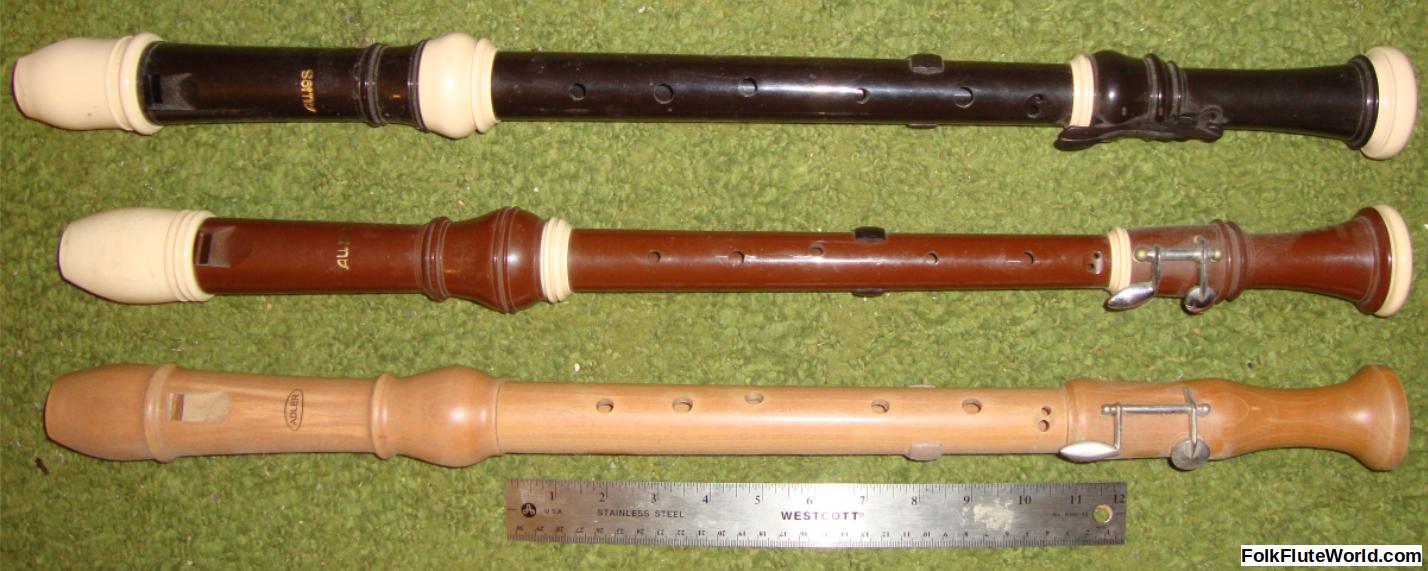
Given that all three instruments include a single low-C key, I don't think anyone would have trouble reaching any holes unless they have especially small hands.
The downside is that the key makes a clickety noise when you use it. This is true both of the Adler and every other keyed tenor I've ever played. You probably won't notice those soft clicks when playing, but you may well recognize them when listening to a recording of yourself playing.
The Adler pictured above has but a single key. This means you can play low C, but not low C#. Adler also makes a more expensive double key version that allows for playing both low C and low C#. When you buy a tenor, this is a consideration. Will the key enable you to play both low C and low C#, or just low C?
Adding a Thumb Rest
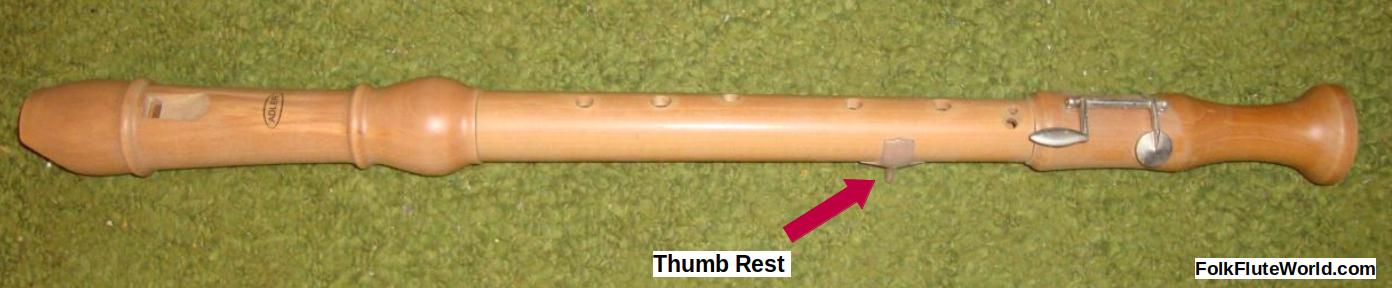
Given their size and weight, most tenor recorder players prefer a thumb rest on the back side of the instrument for their right hand.
And like most tenors, the Adler does not provide one. You'll have to buy one for a few dollars from a music store or online. This photo shows where you place it.
Some thumb rests attach tightly just by pressure. Others may require a touch of glue to hold them in place. Just be sure you're happy you've positioned it in the most comfortable place for your playing style before you glue it!
Playing It
The sound of the Adler is exactly as you would expect: it's the warm voice of maple.
Here's a brief sound sample, an on-the-spot improvisation. The sample has not been altered or edited in any way, and was recorded in a basement stairwell with a cheap recording device.
The tenor is soft-spoken compared to higher-pitched instruments like the soprano or even the alto. One big advantage to the lower-pitched tenor is if you have roommates or housemates whom your soprano bothers. The soft-voiced tenor largely solves this problem.
The Adler's intonation is reasonably accurate. But one must adjust breath strength to hit each note throughout the scale with absolutely precise pitch. Thus you need to learn to hit notes pitch-perfect by adjusting your breath to the specific instrument you're playing.
You won't have this issue with Yamaha or Aulos plastic recorders. Serious recorder players would find this touchiness unacceptable, but I only play my own instrument and have little trouble instinctively adjusting to its peculiarities.
Versus the Soprano
If you're accustomed to playing a soprano, you'll soon discover that all tenors, whether plastic or wood, poorly articulate fast finger-work in comparison. This is simply a matter of physics -- it takes more time to alter airflow through a larger tube. So keep your quick-fingered jigs for your soprano, and employ the tenor where it plays best, in slower, dramatic melodic lines. Or, have fun with it in playing "bass" parts in ensembles.
Another difference you'll notice with the tenor versus the soprano: it takes more breath to play it. You're forcing more air through a larger tube. So breathing techniques become more important to ensure you play pieces properly. You have to learn this so that you don't break up melodic phrasing by running out of breath at the wrong times.
One advantage to the tenor is that, since it is pitched one octave below the soprano recorder, you can read and play soprano music with it. Both are keyed in C major (in contrast to the alto and bass, which are keyed to F). This is useful because so much recorder music is written for the soprano.
The Bottom Line
If you're an ace recorder player, this instrument won't be your tenor of choice. You'll gladly lay out the hundreds required to get a very high quality wooden instrument.
For the rest of us, those who love our plastic recorders but still crave that special warm sound of wood, this tenor fits the bill. It's a good, solid instrument, and a great bargain at its price.
I've had a lot of fun with mine, and would definitely recommend it to others.==> See my complete Beginner's Guide to the Tenor Recorder for more information about tenor recorders, how to play them, and where to get free resources.
Related Articles
You may be interested in my related articles:
* How to Repair and Maintain Recorders - The Complete Guide
* The Ultimate Guide to Garklein Recorder
* The Ultimate Guide to Bass Recorder
***** SUMMARY *****
Instrument: Adler Tenor Recorder
Material: Maple
Pitch: C major, one octave below a soprano recorder
Range: Standard range of about 2 octaves
Fingering: Baroque
Length: apx 25"
Components: 3-piece construction
Keys: Single key version plays Low C, double key version plays Low C and Low C#
Cost: Varies, usually around $80 to $100 USD