by Howard Fosdick © FolkFluteWorld.com
This is a review of the Fabio Menaglio Alto C Ocarina. It is labeled a DO 3 ocarina, as per the Italian system for identifying keys.
Its lowest note is C5. That's the exact same base note as the Soprano recorder.
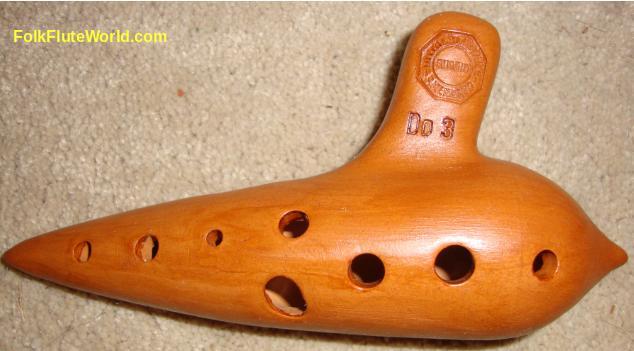
Here's how this instrument looks. You can see the fine reddish-brown clay from which it's made, and the official Menaglio/Budrio stamp on the instrument's neck:
About Budrio Ocarinas
The modern transverse ocarina was invented by Giuseppe Donati in Budrio, Italy, in 1853. Donati was a teenage brick maker who ran across one of primitive vessel flutes circulating in Europe at that time.
The young designer applied his inventive mind to modifying those vessel flutes into modern instruments that could play a standard western scale. His creations had 8 top holes and 2 thumb holes beneath, and could play a compete chromatic scale.
As Donati started making his ocarinas in different sizes, he classified them as Settimino di Ocarine: C1, G2, C3, G4, C5, G6, C7. The letter stands for the key, and the number is the size. Today's Alto C is the C3 ocarina, or DO 3 in the modern European identification system.
(Courtesy: Phamoxmusic.com)
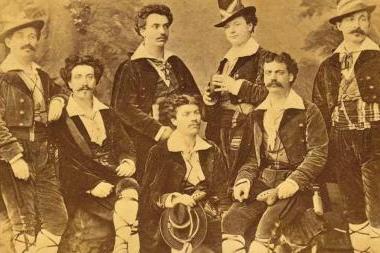
Guiseppe didn't stop at inventing the modern ocarina. He aggressively popularized his new instrument. He placed his "little geese" -- ocarinas in Italian -- into the hands of professional musicians.
They formed the Gruppo Ocarinistico Budriese (the Budrio Group), which they named for their hometown of Budrio, Italy.
GOB played all over Italy and eventually throughout Europe. The tradition of the ocarina ensemble was born.
The result was that Mr Donati firmly established the ocarina as a respectable musical instrument throughout Europe.
Fabio Menaglio and His Ocarinas
Fabio Mengalio continues the proud tradition of Budrio ocarinas. He started crafting them in 1989. You can see his official stamp on the neck of the ocarina in the topmost photo, and in this one:
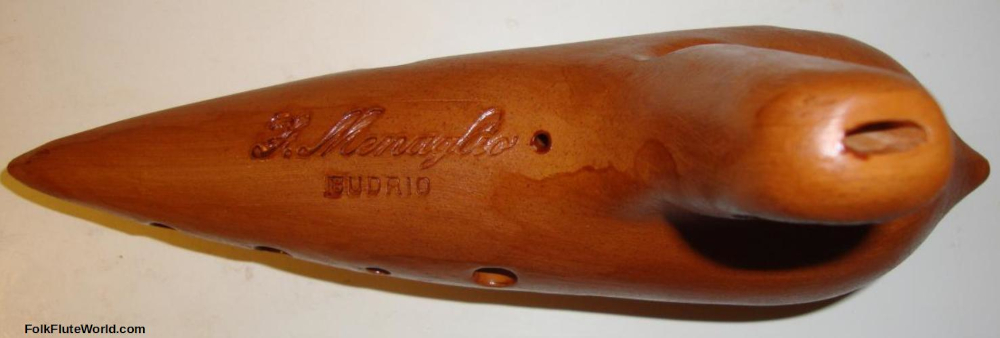
In keeping with tradition, Mr Mengalio molds his instruments from the reddish-brown clay seen in the photo. (You can also purchase glazed ocs but the red-brown terra cotta clay comprises the main offering.)
Menaglio ocarinas come in several standard pitches: DO 1, SOL 2, DO 3, and SOL 4. These correspond to the base notes of C6, G5, C5, and G4. Some might label these C Soprano, G Soprano, Alto C, and G Tenor.
In continuing the Budrio tradition, these ocarinas have 10 tone holes. They have 8 holes on top and 2 thumb holes beneath.
They do not have the tiny "subholes" that many modern ocs feature. That gives them an 11 whole note range. For the Alto C, that ranges from C5 up to F6.
This is two whole notes fewer than today's standard 12 hole ocarina, which ranges from A4 to F6. (Of course, all these ocarinas play all chromatics within their range.)
The fingering for the 10 hole Italian oc differs a bit from the standard 12 hole fingering. These differences include:
2. High E differs from 12-holers
3. A few of the chromatics differ as well
If you're used to 12 hole fingering, you'll find these differences minor and should be able to adapt to them quickly. However, you do have to be aware of them.
Are Fewer Holes Better?
The 12 hole ocarina offers superior range to the 8 hole oc by two whole notes. Specifically, they give you Low A, Low B, and Low A#/B♭. All these are beyond the low end of the 10-holer's range.
Yet many experts opine that fewer holes are better. For example, respected ocarina-maker Richard Hamlett states on his website that:
Similarly, expert maker Richard Hickman dedicates a webpage to "... Why 10 and 11 hole ocarinas are better than 12 hole ocarinas." He argues that:
I hestitate to differ with experts such as these, who craft ocarinas and know much more about their design than I. Yet, to my ear the best 12 hole ocs sound every bit as good as any 11 or 10 holer.
Specifically, I cite the ceramic Focalink Pastoral series and the plastic Night By Noble as 12 hole Alto C's that perform as well as their 11 or 10 hole competitors.
But what I think doesn't matter. When you buy an oc, you want it to match your tastes.
The best way to achieve that is to listen to sound samples and hear the Menaglio instruments in action. You'll be impressed by their quick responsiveness in fast pieces, and their lovely dulcet tones in slow melodies.
You can listen to many sound samples at Youtube simply by searching on "Fabio Menaglio Ocarina". Or listen to the recordings at the Fabio Menaglio Youtube channel.
Purchasing and the Website
To purchase this ocarina, you'll want to access the Ocarina Budrio website. It's in Italian, but most browsers will display a TRANSLATE button you can click on to read it in English.
If you're located outside Italy, the website also has a button at the top labeled: Enter here for purchases outside Italy.
The website displays photos of all the Menaglio ocs and features a brief sound sample for each size. You'll want review these prior to ordering.
Prices for these ocarinas can vary, depending on currency conversions, shipping fees, and tariffs. At the time of writing, the standard red/brown DO 3 Alto C oc goes for about € 50. It ships in a beautiful box befitting its status as a fine instrument.
You'll have to check current prices, but at the moment the Soprano DO 1 sells at € 30, while the largest SOL 4 is at € 61.
Summary
The Mengalio ocarinas are premier examples of fine Italian craftsmanship. They embody a tradition that harkens back to the first modern ocarinas.
The prices are very reasonable for such unique, beautifully made pieces.
In Brief
- Style: 10-hole transverse ocarina
- Maker: Fabio Menaglio of Budrio, Italy
- Website: Ocarina.IT
- Range: For the Alto C, from C5 - F6 including all sharps and flats
- Material: Ceramic (red/brown clay, aka terra cotta)
- Price: Varies by country, due to currency conversions, shipping, and taxes. In Italy, the Alto C (DO 3) costs about € 50.
- Dimensions: For the Alto C, Length: 6.5 inches (159 mm), Width: 3.25 inches (88.5 mm), Height: 1.5 inches (38 mm)