© FolkFluteWorld.com
New for 2026
This review covers STL Ocarina's Tapion ceramic bass ocarina.
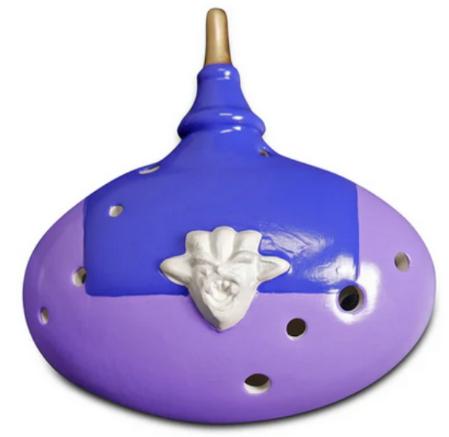
(Courtesy of STL Ocarina)
This ocarina was inspired by the film and gaming series Dragon Ball Z and its hero, Tapion.
It's the Hero's Flute from the film.
As Tapion describes this magic ocarina to Bulma:
"A wizard found it in the wraith's temple. Along with the blade, two ocarinas were discovered. My brother and I used them in hopes of distracting the beast. They must have been enchanted as well, for neither one of us knew how to play. The melody seemed to consume Hirudegarn with rage. But try as it might, the beast could do us no harm." -- DragonBall.Fandom.com
Tapion discovers that his enchanted Hero's Flute produces a magic barrier and distracts the evil Hirudegarn at critical times.
Looks
I've never seen the films myself. But from the standpoint of presentation, this is one of the coolest looking transverse ocarina designs I've ever seen. The two-tone purple is rendered perfectly, with the gold mouthpiece making a nice contrast.
I don't know what the emblem stands for in the films, but to me it appears like a mask from an ancient Greek temple. Some might call it a ferocious grimace, but I think it appears spooky or otherwordly.
The shape of this ocarina is unique. It's a perfect oval, with the mouthpiece centered off one side. That's quite different than traditional transverse oc with its submarine shape and angled mouthpiece.
Quality
I've ordered many ocs from STL Ocarina and never received anything other than a professionally-made instrument. This is a quality ocarina.
The instrument plays in tune with itself across the scale. That's important. It's easy to find fun or fancy ocarina designs. It's quite another thing to find intriguing designs that also play in tune with themselves.
Packaging for shipping is very secure. The chances of receiving a broken or damaged item are about zero.
Play and Sound
You finger this oc just like any other transverse ocarina. So any training materials or sheet music you have for other ocarinas work for this one as well.
Being a 10-hole oc, the Tapion produces a range of 11 notes (from C4 to F5), with all sharps and flats between.
That's two whole notes fewer than you can play with a 12-hole transverse ocarina. But it's typical for basses. These lower instruments don't articulate well with 12 holes, so the typical bass transverse has either 10 or 11 holes.
The Tapion is a C major instrument. It's lowest note -- C4 -- is one octave lower than that of the most common ocarina (the one that almost everyone except STL Ocarina calls the Alto C). C4 is also one octave lower than the base note of the Soprano recorder.
The Tapion gives you that deep bass sound that many love. It's produced from ceramic so it has that traditional timbre.
Here's the sound sample featured on STL Ocarina's website. Tapion's Theme sounds positively inspiring on this instrument ...

(Courtesy: STL Ocarina)
One way in which this oc differs from the typical transverse is that your fingers wrap around the body. See these photos:
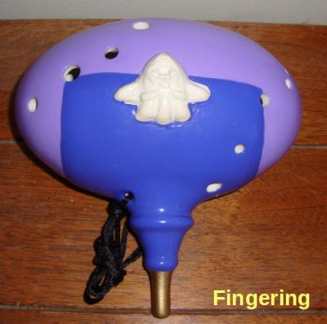
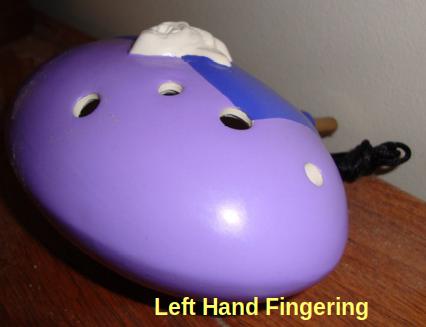
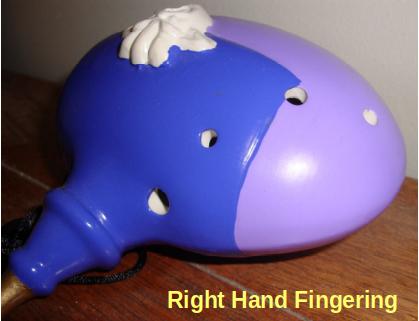
(Photos by the author)
You can see that your fingers wrap around the curvature of the instrument to a greater degree than with a typical transverse ocarina. I found it took some time to become accustomed positioning my righthand fingers due to this design.
When I switch through several instruments in a session I have to be conscious of adjusting my righthand fingers when I pick up the Tapion.
Should You Buy This Oc?
This is a quality instrument, yet it's priced much lower than you would expect to pay for a ceramic bass. It typically costs around $70 USD.
That's a huge savings compared to the typical bass that retails for $200 -- or more. And the Tapion sounds as good as an expensive instrument.
This oc will appeal to a variety of musicians. You might want to buy it if you:
- Are a fan of the Dragon Ball Z films or video games
- Would like a unique, cool collectible
- Want a quality ceramic bass oc but have been put off by their price
- Need a quiet oc that won't bother your housemates
- Need a ceramic bass to complete your set of ocarinas
About the only possible downside is the somewhat unusual finger positioning, as opposed to those of more traditionally-shaped transverse ocarinas. Most people won't be bothered by this as you quickly get accustomed to it.
**** SUMMARY ****
Style: 10-hole transverse style
Pitch: Bass C
Range: 11 whole notes, from C4 to F5, with all sharps and flats in between
Material: high-quality ceramic
Cost: apx. $70 USD (plus any shipping)
Dimensions: apx 6" long, 6" wide (from tip of mouthpiece to opposite edge)
Available from: STL Ocarina