by Howard Fosdick © FolkFluteWorld.com
(Courtesy:
JusiqueClassique.Forumpro.fr)
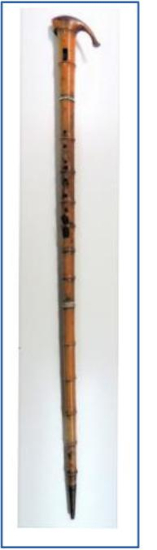
Have you ever heard of a csakan? Sometimes called the "walking stick recorder" or the "cane flute", it combined a walking stick and a recorder into one.
If that seems odd to us today, it didn't seem so to the denizens of Austria-Hungary in the early to mid- 19th century.
At the time, walking sticks were quite popular, and dual-use items were considered fashionable. You could find walking sticks combined with telescopes or swords, for example. Mating one with a recorder seemed like a natural fit for the stylish, educated gentleman. The instrument's mouthpiece was originally in the cane's handle, and fingering holes were arranged across the stick.
So it was that at a time when the recorder had faded into obscurity elsewhere in Europe, in the 1820s to the 1850s they were popular in this form in Austria-Hungary.
The csakan faded into complete historic obscurity by World War I. That's when the Austrian-Hungarian Empire's disastrous participation on the losing side of the conflict resulted in its dissolution.
You might also see the instrument's name spelled as czakan or tsakan.
Background
(Courtesy: Wikipedia)
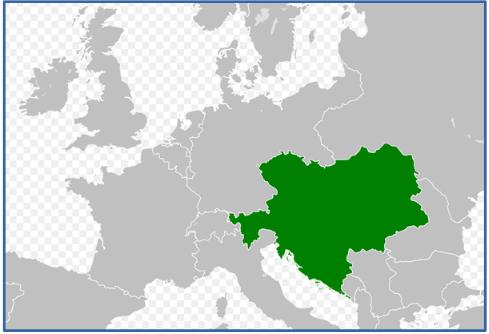
Since the csakan was a development of the recorder specific to Hungary and the Austrian-Hungarian Empire of the 19th century, it helps to know a little of the history of the era.
Though today we think of Austria and Hungary as relatively small landlocked countries -- population 10 million each -- for centuries they constituted an important power in central Europe. In 1867, Austria combined with Hungary into the Dual Monarchy, the multi-ethnic nation known as the Austrian-Hungarian Empire.
So important was this central European state that it was the assassination of its throne's heir that started World War I in 1914. Some 15 to 20 million people died as a result.
Today you can still see the imperial architecture that bespoke the region's importance in cities like Vienna and Budapest. This culture was long known for its music and its many famous composers such as Mozart, Schubert, Haydn, Strauss, and Schoenberg.
So it was natural that a fine instrument like the recorder would be further developed there, in this case, into the csakan.
Evolution and Types
(Courtesy: by J. Ziegler @ WennerFloeten.de)
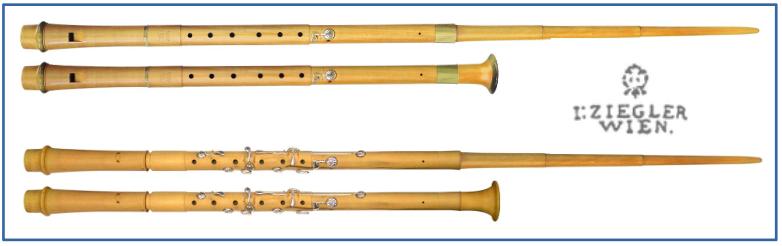
The csakan evolved a good bit over its hundred year history. Early types were either keyless or had a single key, like other recorders (See above photo). Some had pointed walking sticks ends, while others featured more modern bells.
The extended straight handle shown in the first photo in this article eventually disappeared in favor of the knob handle mouthpiece shown here.
Various woods were used but most prominent was European boxwood. Boxwood appears yellow, as the photo shows.
While fingering variations exist, this was a recorder. So it generally fingers the same as any other baroque recorder. The fundamental or base note was usually A♭ (or G or A). Typical range might be from A4♭ to E7♭ (or G4 to G7, depending on tuning).
Early csakan were keyless or had one key. These are called simple csakan (or einfacher in German). The sole key was for playing low D# (see above photo).
As it was the trend in the 19th century to add keys to instruments, soon 6 and 7 keyed csakans evolved. The goal was to improve tonal accuracy for the accidentals and also aid ease of play. These were called complicated csakan or complizierter. The keys were for playing D#, G♯, F, F♯, B♭, low C♯, and a trill key for B-C. It was popular for the tops of key covers to look like miniature shells. Eventually some csakan had up to 13 keys.
How They Sound
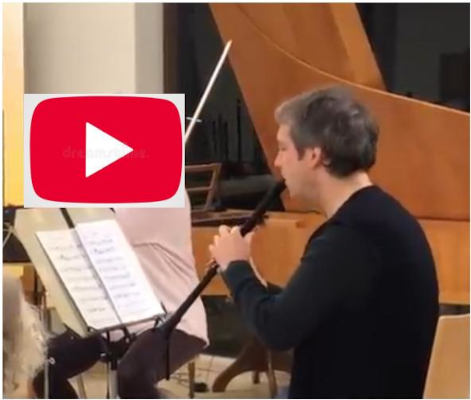
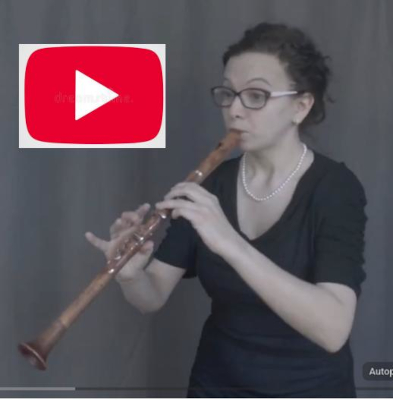
Csakan are usually described as "sweet sounding". They sound very similar to fine alto recorders. Here are a couple sound samples from Youtube. (You can find others by a simple Youtube search.)
Use
Hungarian Anton Heberle is credited with inventing the csakan in about 1807. In that year he performed with one in concert in Budapest.
Composers starting writing specifically for the csakan (as no one still scored for the recorder). Eventually a body of some 400 to 500 compositions accumulated. Heberle, Ernst Krähmer, A. Diabelli, and J.K. Hunyadi were among the most prolific.
Krähmer (1870), Köhler (1880) and Barth (1910) wrote training books (or methods) for the csakan. Over time, as the instrument accumulated keys and evolved into a 6 key flute, the csakan was used in educational settings. These were tuned in the more common key of C. They're sometimes referred to as Vogtland Csakan, or by other names.
By the end of the first World War, csakan had become an historic rather than a living instrument. Its fate was that of the recorder. It fell before the onslaught of metal instruments with keys for every note. These were thought to be more modern and they had three advantages over simple flutes:
* Their keys made accidentals more tonally accurate
* Keys gave them greater range than simple flutes
The keyed csakan was squeezed out, as it existed somewhere between simple keyless flutes and fully keyed metal concert instruments. It eventually suffered the same fate as the recorder, destined for obscurity.
But while recorders rose from the dead to become widely popular present day instruments, the csakan largely remains a historical curiosity. Its few fans are those who either have an interest in central European culture or historic instruments.
Purchase
If you can't find a 19th century csakan for sale, several European makers of fine flutes could accomodate you. Mollenhauer sells them, for example. Prices are generally as high as the finest recorders.
Conclusion
The csakan represents a fascinating historical detour in recorder development. It kept the instrument alive during the 19th century, yet today is mainly of historic and cultural interest. Its beautiful voice matches that of other fine recorders.
Related Articles
You may be interested in my related articles: