by Howard Fosdick © FolkFluteWorld.com
Ever heard of a sopilka? It's an end blown flute, somewhat similar to a recorder or tin whistle, that hails from Ukraine. In fact, it's considerded one of Ukraine's national instruments, and a big part of the country's musical heritage.
Sopilkas trace back hundreds of years in various forms. Today their most common design has 10 fingering holes, 8 on top and 2 underneath for your thumbs. This design was invented in 1967 by instrument maker Dmytro Florovych Demenchuk (1942–2010) and has since become predominant. It's what most people mean when they refer to a "sopilka" today.
With its 10 fingering holes, the sopilka is in many ways an advancement on the common recorder. Yet it also shares some characteristics of the tin whistle:
2. The bore is straight like many tin whistles (instead of being conical or tapered like a recorder's)
For more background on sopilkas and how to play them, see my complete background article on them.
This article is simply a review of two sopilkas I purchased. One is a soprano in C keyed to C5, just like a soprano recorder. The other is an alto in F keyed to F4, just like an alto recorder. Both are made from hornbeam and were purchased from WoodwindUA at Etsy.com.
Here's a photo of these two instruments:
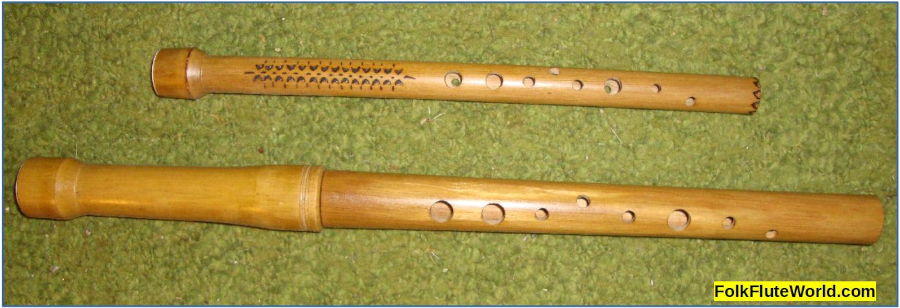
Soprano and Alto Sopilkas
The Instruments
As the above photo shows, these instruments are beautiful in hornbeam. The soprano has decorative filigree and both came packaged in an ethnic Ukrainian cloth. Here's a photo from the vendor of the soprano:
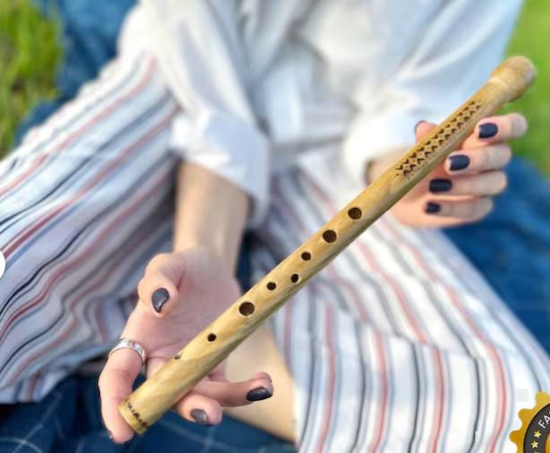
Note the blunt end mouthpieces characteristic of sopilkas. All have this blunt end with breath slit. Yet they are duct flutes just like recorders and tin whistles -- they automatically direct your breath through the windway and into the splitting edge that produces the sound waves.
The instruments arrived in very secure packaging. The chances of damage in shipping would appear to be very low.
The instruments sound as you would expect of any straight bore end-blown wood flute. They hit notes up into the third octave without sounding shrill or harsh.
My only complaint would be that tonal accuracy is a bit off on some of the sharps and flats. This is as you might expect -- these are folk instruments, not concert instruments. And they cost much less than fine recorders. The soprano was $51 USD ($55 including shipping) in 2026, and the alto was $83 ($89 including shipping).
One recommendation for improvement -- neither instrument came with a fingering chart. I was only able to find a single chart online, with commentary in Ukrainian. A fingering chart would have been a great help while learning to play the instrument.
.Verify Before You Buy
As folk instruments, sopilka are not standardized. Plus, the wording for different kinds of Ukrainian flutes sometimes gets lost in translation to English.
Thus you can find 6 holed wood pennywhistles (aka tin whistles) labeled as "sopilka" by some vendors, as well as overtone flutes that have no fingering holes at all. (See my article on overtone flutes here.)
In my case, my alto flute was marketed as a "tenor" in F. At least by recorder standards, that would be called an "alto" in F. No matter, as long as you verify the key, base note, and number of fingering holes before you buy.
So before you purchase any sopilka, verify how many fingering holes it has, and the instrument's base note and key.
Conclusion
The two sopilka I bought from WoodwindUA are fine instruments and exceptional values for their price. They project a sweet wood flute sound, and come with attractive decorative filigree.
If you already know how to play recorder, transitioning to the sopilka is fairly easy. But the fingering does differ and you might get confused if you frequently shift between the two instruments unless you have a pretty good memory for fingering differences.
Related Articles
You may be interested in my related articles:
* All About Recorders
* The World's Smallest Recorder
* Beginner's Guide to Tenor Recorder
* Ultimate Guide to Bass Recorder
* Are Adler Recorders Any Good?
* How to Fix and Maintain Your Recorder - A Complete Guide
* The Csakan - The 'Walking Stick' Recorder
* What's a Flageolet?